


Main Points In Hindi (मुख्य बातें – हिंदी में)
-
नवीन शोध मॉडल: स्पेन के शोधकर्ताओं ने हेजरो जैतून के बागों में कृषिवोल्टिक सुविधाओं के लिए एक नया मॉडल विकसित किया है, जो सटीकता से तेल और ऊर्जा उत्पादन का अनुमान लगाने में सक्षम है।
-
उच्च स्तर का मशीनीकरण: हेजरो जैतून के बागों में उच्च स्तर का मशीनीकरण और कम लागत का लाभ होता है, जो इन्हें स्पेन और पुर्तगाल में नए बागों के डिजाइन में लोकप्रिय बनाता है।
-
सौर विकिरण का अनुकरण: शोध में शामिल मॉडल सौर विकिरण और फसलों के बीच बातचीत पर ध्यान केंद्रित करता है, जिससे यह समझा जा सकता है कि किस प्रकार सूरज की रोशनी फसलों के द्वारा अवशोषित की जाती है।
-
विकिरण संचरण का अध्ययन: मॉडल अदालत द्वारा जैतून की चंदवा में विकिरण संचरण का अनुमान लगाता है, जो फसल की उपज और सौर ऊर्जा उत्पादन में सहायता करता है।
- छाया और उत्पादन: यह दृष्टिकोण सौर पैनलों के कारण होने वाली छाया के प्रभाव को ध्यान में रखते हुए तेल और बिजली के वार्षिक उत्पादन का सही अनुमान लगाने की क्षमता प्रदान करता है।
Main Points In English(मुख्य बातें – अंग्रेज़ी में)
Here are the main points from the article:
-
New Agrivoltaic Model: Spanish researchers have developed a new model to accurately estimate oil and energy production in agrivoltaic facilities set up in hedgerow olive groves.
-
Innovative Approach: The proposed model integrates mathematical equations to assess the impact of system design variables, allowing for simulations of solar radiation absorption by crops.
-
Benefits of Hedgerow Olive Groves: Compared to traditional olive groves, hedgerow designs facilitate high levels of mechanization and lower costs, with added advantages such as easier pest control and irrigation.
-
Simulation Insights: The researchers found that oil production per unit length is maximized when tree rows are spaced farther apart, although wider spacing reduces the overall number of olive trees per hectare.
- Publication and Future Research: The findings are published in the "Cleaner Production Journal," and researchers from Córdoba University have developed additional methods for optimizing land use for agriculture beneath dual-axis solar trackers.

Complete News In Hindi(पूरी खबर – हिंदी में)
स्पेन के शोधकर्ताओं ने हेजरो जैतून के बागानों में निर्मित कृषिवोल्टिक सुविधाओं में तेल उत्पादन और ऊर्जा उत्पादन का सटीक अनुमान लगाने के लिए एक नया मॉडल बनाया है। प्रस्तावित दृष्टिकोण सिस्टम डिज़ाइन चर के प्रभाव का अनुमान लगाने वाले गणितीय समीकरणों की पीढ़ी की भी अनुमति देता है।
के शोधकर्ता कॉर्डोबा विश्वविद्यालय स्पेन में हेजरो जैतून के बगीचों में तैनात एग्रीवोल्टिक संयंत्रों में सौर विकिरण का अनुकरण करने के लिए एक मॉडल विकसित किया है।
पारंपरिक जैतून के बागों की तुलना में, हेजगेरो जैतून के बाग उच्च स्तर के मशीनीकरण और कम लागत की अनुमति देते हैं। वे आम तौर पर स्पेन और पुर्तगाल में फैले हुए हैं, जहां वे क्रमशः 100,000 हेक्टेयर और 120,000 हेक्टेयर पर कब्जा करते हैं, और वे नए बागानों में सबसे आम बाग डिजाइन बन रहे हैं, खासकर भूमध्य सागर से दूर उत्पादन क्षेत्रों में। ये बाग उच्च पौध घनत्व, आसान रोग और कीट नियंत्रण, और आसान सिंचाई और प्रजनन जैसे लाभ भी प्रदान करते हैं।
शोध के मुख्य लेखक, मार्ता वरो मार्टिनेज ने बताया, “हमारा उपकरण सूर्य से फसल तक पूरे रास्ते में विकिरण, यहां तक कि फसल की छतरी के माध्यम से विकिरण अवशोषण को अनुकरण करने के लिए मॉडल को एकीकृत करता है।” पीवी पत्रिका. “मॉडल न केवल बिजली उत्पादन बल्कि तेल उत्पादन का भी आकलन करने की अनुमति देता है।”
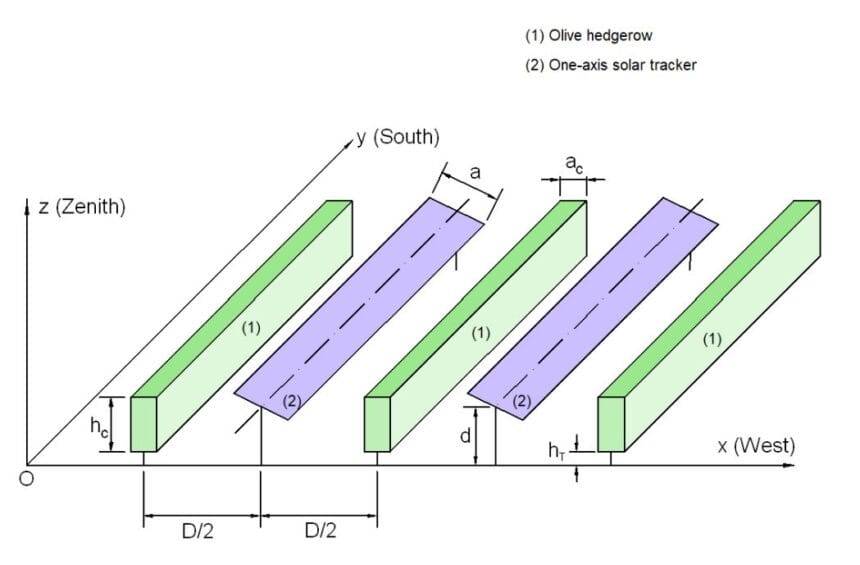
प्रस्तावित मॉडल क्षैतिज ट्रैकर्स का उपयोग करके दक्षिण-उन्मुख एग्रीवोल्टिक सुविधा में सौर विकिरण, सौर मॉड्यूल और फसल उगाने के बीच बातचीत पर विचार करता है। प्रस्तावित सिस्टम कॉन्फ़िगरेशन में, तेल और ऊर्जा उत्पादन दोनों को वैकल्पिक रूप से सौर पैनलों के बीच प्रत्येक लेन में एक जैतून ग्रोव हेडगेरो के साथ जोड़ा जाता है।
मॉडल वैश्विक सौर विकिरण और प्रकाश संश्लेषक रूप से सक्रिय विकिरण (पीएआर), साथ ही उनके प्रत्यक्ष और फैले हुए घटकों को ध्यान में रखता है। अनुसंधान दल ने कहा, “एक बार जब फसल में घटना विकिरण का पता चल जाता है, तो जैतून की छतरी के अंदर विकिरण संचरण का अनुमान लगाना आवश्यक हो जाता है।” “चंदवा के भीतर अवशोषित विकिरण के स्थानिक वितरण को निर्धारित करने के लिए, यह माना जाता है कि फसल हेजरो को आसन्न समानांतर चतुर्भुज में विभाजित किया गया है।”
उपकरण को दक्षिणी स्पेन के कॉर्डोबा में स्थित एक दक्षिण-उन्मुख अधीक्षण गहन जैतून फार्म में अलग-अलग पंक्ति रिक्तियों के साथ लागू किया गया था। पीवी प्रणाली को खगोलीय ट्रैकिंग और बिना बैकट्रैकिंग वाले ट्रैकर्स पर आधारित माना गया था। शिक्षाविदों ने समझाया, “रोटेशन की धुरी की ऊंचाई 0.5 मीटर चरणों पर 2.5 मीटर से 3.5 मीटर तक होती है और मॉड्यूल की चौड़ाई 1 मीटर चरणों पर 2 मीटर से 4 मीटर तक होती है,” यह देखते हुए कि मॉडलिंग ने 81 विभिन्न ज्यामितीय संयोजन उत्पन्न किए .
सिमुलेशन ने हेजरो के प्रत्येक प्राथमिक समानांतर चतुर्भुज के भीतर अवशोषित PAR के वितरण को प्राप्त करने की अनुमति दी और पता चला कि हेजरो की प्रति यूनिट लंबाई में तेल उत्पादन की उच्चतम मात्रा पेड़ की पंक्तियों के बीच सबसे बड़ी दूरी से प्राप्त की जा सकती है, जो बदले में एक उच्च अवरोधन की अनुमति देती है। सौर विकिरण का. “हालांकि, व्यापक रिक्ति का उपयोग करने से प्रति हेक्टेयर हेजरो की संख्या में कमी आती है, जिससे प्रति इकाई क्षेत्र में तेल उत्पादन में कमी आती है,” टीम ने जोर दिया।
कथित तौर पर प्रस्तावित दृष्टिकोण सौर पैनलों के कारण होने वाली छाया के प्रभाव के साथ-साथ तेल और बिजली के वार्षिक उत्पादन का सटीक अनुमान लगाने में सक्षम बनाता है। यह सिस्टम डिज़ाइन चर के प्रभाव का अनुमान लगाने वाले गणितीय समीकरणों की पीढ़ी की भी अनुमति देता है। वेरो मार्टिनेज़ ने कहा, “ये समीकरण परीक्षण की गई सबसे छोटी अंतर-दूरियों के साथ सर्वोत्तम उपयोग खोजने के लिए डेटा की प्रवृत्ति को भी दर्शाते हैं।”
उनके निष्कर्ष अध्ययन में पाए जा सकते हैं “ऑलिव हेजरो एग्रीवोल्टिक प्रणाली की विद्युत और कृषि उत्पादकता के लिए सिमुलेशन मॉडल,” में प्रकाशित क्लीनर उत्पादन जर्नल.
शोधकर्ताओं का एक अन्य समूह कॉर्डोबा विश्वविद्यालय हाल ही में विकसित ए नई विधि यह गणना करने के लिए कि दोहरी-अक्ष सौर ट्रैकर्स के आधार पर फोटोवोल्टिक संयंत्रों के तहत कृषि उद्देश्यों के लिए कितनी भूमि का उपयोग किया जा सकता है।
यह सामग्री कॉपीराइट द्वारा सुरक्षित है और इसका पुन: उपयोग नहीं किया जा सकता है। यदि आप हमारे साथ सहयोग करना चाहते हैं और हमारी कुछ सामग्री का पुन: उपयोग करना चाहते हैं, तो कृपया संपर्क करें: editors@pv-magazine.com.
Complete News In English(पूरी खबर – अंग्रेज़ी में)
Researchers in Spain have developed a new model to accurately estimate oil and energy production from agrivoltaic systems in hedgerow olive groves. This approach allows for the generation of mathematical equations to predict the impact of system design variables.
The team from the University of Córdoba has created a model to simulate solar radiation in agrivoltaic installations in hedgerow olive orchards. Compared to traditional olive groves, hedgerow designs offer higher mechanization levels and lower costs. These groves cover significant areas in Spain and Portugal—100,000 hectares and 120,000 hectares, respectively—and are emerging as a common design for new groves, particularly in production areas away from the Mediterranean. They provide benefits like higher plant density, easier pest and disease control, and simplified irrigation and reproduction.
Lead researcher Marta Vero Martinez stated, “Our tool integrates a model to simulate radiation all the way from the sun to the crops, including the absorption of radiation through the crop canopy.” This model can estimate both electricity and oil production.
The proposed model considers the interaction between solar radiation, solar modules, and crop growth in south-facing agrivoltaic setups using horizontal trackers. In this system configuration, both oil and energy production can be alternately integrated with hedgerow olive groves in between solar panels.
The model takes into account global solar radiation and Photosynthetically Active Radiation (PAR), including direct and diffuse components. The research team noted, “Once the incident radiation on the crop is determined, it’s crucial to estimate the radiation transmission within the olive canopy,” assuming that the crop hedgerow is divided into adjacent parallel quadrants.
The model was applied in a south-facing intensive olive farm in Córdoba, Southern Spain, with varying row spacing. The PV system was based on astronomical tracking and non-backtracking trackers. The researchers explained, “The height of the rotation axis ranges from 2.5 to 3.5 meters in 0.5-meter increments, and the width of the modules ranges from 2 to 4 meters in 1-meter increments,” leading to the generation of 81 different geometric combinations.
Simulations allowed for the determination of PAR distribution absorbed within each primary parallel quadrant, revealing that the highest oil production per unit length of hedgerow can be achieved with greater spacing between tree rows, which allows for more solar radiation to reach the crops. However, using wider spacing reduces the overall number of hedgerows per hectare, consequently lowering oil production per unit area.
The proposed approach can accurately estimate the effects of shading caused by solar panels on annual oil and electricity production. It also enables the generation of mathematical equations to predict the impact of design variables. Vero Martinez added, “These equations reflect the data trends for finding the best usage with the smallest tested inter-row distances.”
Their findings are published in the article, “Simulation Model for the Electrical and Agricultural Productivity of Olive Hedgerow Agrivoltaic Systems,” in the Cleaner Production Journal.
Another research team from the University of Córdoba has recently developed a new method to calculate how much land can be used for agricultural purposes under photovoltaic plants based on dual-axis solar trackers.
Source link