


Main Points In Hindi (मुख्य बातें – हिंदी में)
Here are 3 to 5 main points from the provided content:
-
Controversy Over LNG Emissions Research: A preprint paper by Robert Howarth studying the greenhouse gas emissions of liquefied natural gas (LNG) exports from the U.S. has sparked significant debate and criticism, with its findings suggesting that shipping U.S. LNG results in higher overall greenhouse gas emissions compared to coal.
-
U.S. Role in Natural Gas Exports: The U.S. has become the world’s largest exporter of crude oil and natural gas, with natural gas exports having increased dramatically following the European energy crisis triggered by Russia’s invasion of Ukraine. This rise in exports has led to higher domestic prices for natural gas in the U.S.
-
Impact of Methane Emissions: The paper emphasizes the importance of considering methane emissions—gas that is significantly more potent as a greenhouse gas than carbon dioxide. It underscores that existing assessments do not account for methane leakage during the extraction, processing, and distribution of natural gas.
-
Regulatory Developments: In response to concerns over the environmental impacts of LNG, the Biden administration imposed a temporary pause on new LNG export approvals to non-free trade countries while the Department of Energy updates its assessments on LNG’s economic and environmental impacts.
- Criticism of the Natural Gas Industry: Critics argue that the natural gas industry has marketed itself as a cleaner alternative to coal, despite evidence suggesting that high methane leakage and the emissions from LNG shipping negate its benefits. The ongoing debate highlights the challenges of transitioning to cleaner energy sources amid the complexities of the fossil fuel industry.
Main Points In English(मुख्य बातें – अंग्रेज़ी में)
Here are 5 main points from the provided content discussing the contentious peer review of a preprint paper on liquefied natural gas (LNG) emissions:

-
Contention Over LNG Emissions: The preprint paper by Robert Howarth argues that exporting U.S. LNG to replace coal burning in other countries results in higher overall greenhouse gas emissions, making it an ineffective climate solution. This assertion contradicted the narrative that natural gas is a cleaner alternative to coal.
-
Impact of U.S. Energy Exports: The U.S. has become the largest exporter of crude oil and natural gas, with exports significantly increasing due to geopolitical factors like the invasion of Ukraine. This shift has resulted in increased domestic natural gas prices, raising concerns about energy cost burdens on U.S. consumers while paradoxically promoting fossil fuel usage.
-
Methane Emissions Underreported: Howarth highlights the oversight in emissions reporting related to methane, a potent greenhouse gas. The U.S. primarily reports carbon dioxide emissions, ignoring methane leakage in the natural gas extraction and distribution systems, further complicating assessments of natural gas as a ‘clean’ energy source.
-
Regulatory Delays and Industry Pushback: Following the paper’s release, the Biden administration paused new LNG export approvals to update environmental assessments. This decision prompted backlash from the oil and gas sector, which has a vested interest in maintaining and expanding LNG shipments despite environmental concerns.
- Debate and Criticism on Research Validity: Howarth’s work has faced critique, notably from organizations associated with pro-natural gas advocacy. These critiques often downplay the significant climate impacts of methane emissions and align with the interests of fossil fuel industries. The ongoing discourse reflects deep divisions on energy policy, climate strategy, and the future of fossil fuels in the energy transition.
Complete News In Hindi(पूरी खबर – हिंदी में)
Sign up for daily news updates from CleanTechnica on email. Or follow us on Google News!
For the past year, a preprint paper has been undergoing one of the most public, rancorous and extensive peer-review processes in the history of US academics. Is it on race relations? Tax cuts for the rich? Hollywood starlets? No, it’s on liquified natural gas (LNG) emissions of greenhouse gases.
The paper is The greenhouse gas footprint of liquefied natural gas (LNG) exported from the United States by Robert Howarth, in the open access journal Energy Science & Engineering, 2023 impact factor 3.5. It’s a completely credible journal, and you wouldn’t think that this would be a particularly contentious subject, but this is the United Petrostates we’re talking about.
The United States is now the biggest exporter of crude oil and natural gas in the world, and currently the fourth largest exporter of coal. Natural gas export has rise from 0.3 billion cubic feet per day to 20.9 billion cubic feet, about half of it LNG with the rest being through pipelines to Canada and Mexico. That’s worth about $60 million daily, or about $22 billion annually, up from a tiny fraction of that.
A good deal of that rise was due to Russia’s invasion of Ukraine and the subsequent turning away of the world from cheap Russian gas. The European energy crisis that followed had global energy price repercussions. Oil and gas firms in the United States leapt upon the opportunity to send innumerable ships full of LNG across the Atlantic, something which drove up domestic prices for natural gas for US consumers. This was overlaid upon the global inflation challenge that was driving up prices of everything else. US consumers were feeling the pinch.
Exporting lots of natural gas meant higher prices domestically. That’s a good thing for domestic consumption of the fuel as US prices have been dirt cheap, leading to profligate use and waste of it, something that’s been true of oil products as well. Very cheap fossil fuel energy has been and is continuing to be a serious hindrance to US decarbonization.
And then there’s the narrative. Fossil methane has had some really good marketing, accidental and intentional. It was accidentally labeled as natural gas because it wasn’t town gas, a rather horrendous mixture of hydrogen, methane, carbon dioxide, carbon monoxide and trace noxious elements manufactured from whatever mostly fossil hydrocarbons are convenient and cheap. It was actually a lot better for people to burn it indoors because it didn’t have carbon monoxide, which kills people quite handily. It was natural because it came up from underground mostly in a mixture that would burn fairly cleanly.
Then there’s the intentional marketing, in which natural gas was positioned as a virtuous bridge fuel, a lower carbon, lower pollution replacement for coal. That actually can be true. In a low leakage natural gas system where methane isn’t skewing the results, natural gas provides the same heat with less carbon as a greater percentage of it is hydrogen. And combined cycle gas turbines not only spin the turbines by burning gas, they heat steam with the waste heat to generate more electricity. The combination is a lot more efficient than a coal plant, so once again, less carbon dioxide.
This chart makes it clear that this is working in the USA. For carbon dioxide. The country has been patting itself on the back for this result and using it to assert to the world that the obvious answer to electrical system greenhouse gas emissions is to replace coal with natural gas, especially US natural gas. The export statistics make it clear that that’s worked very well.
The problem is emissions of methane aren’t counted here. Methane emissions related to electrical generation are never reported in the USA, just carbon dioxide. That would be fine if they had a very low leakage extraction, processing and distribution system, and natural gas plants had low slippage, i.e. low emissions of unburnt methane. Consider this foreshadowing.
Into this mix of oil and gas industry greed, hard marketing of a fossil fuel that’s not remotely good for the climate and US citizens’ anxiety about food vs heat, Howarth dropped his preprint. A couple of words about Howarth. He’s a professor at Cornell University. His work has highlighted the significant climate impacts of methane, a potent greenhouse gas, and brought attention to emissions from hydraulic fracturing (fracking). In 2011, Howarth published a widely discussed study showing that methane leakage from shale gas production could make it as harmful to the climate as coal, a conclusion that sparked heated debates in the energy sector. His findings played a crucial role in shaping discussions around U.S. energy policy, especially as the country ramped up natural gas exports. Howarth has consistently advocated for stronger regulations to reduce methane emissions, emphasizing that immediate action is needed to mitigate the worst impacts of climate change. His work has had lasting effects on environmental policy discussions, both in the U.S. and internationally. He’s testified to Congress multiple times.
For full disclosure, I published a series of assessments of competing US and European lifecycle carbon assessments of blue hydrogen, one by Howarth and Mark Jacobson and the other by a group of European academics a few years ago. I found Howarth and Jacobson’s paper much more useful in terms of energy policy, and the European paper too narrowly bound to the best of breed northern European natural gas extraction as well as having a methodological gap on leakages that needed further exploration. I know Mark Jacobson moderately well, having spoken with him several times and exchanged a few notes with Howarth at the time. Subsequently, both Howarth and I contributed chapters to a book published this year, Proven Climate Solutions: Leading Voices on How to Accelerate Change. I haven’t spoken personally to him about the paper or its criticisms, but I looked at them on and off over the past year.
What did the preprint say that caused such a ruckus? That shipping US LNG to other countries to displace their burning of coal there resulted in higher greenhouse gas emissions, so wasn’t a climate solution. Howarth’s history means that the oil and gas industry consider him, if not public enemy #1, then at least in the top 5. This pushed him up the ladder a bit.
In January of 2024, the Biden administration imposed a temporary pause on new approvals for LNG exports to non-free trade agreement countries, allowing time for the Department of Energy to update its analyses of the economic and environmental impacts of LNG exports. Existing assessments were considered outdated and do not account for recent developments such as potential increases in energy costs and the environmental toll of methane emissions. The freeze, which primarily affects large projects like Commonwealth LNG, has sparked debate, to put it mildly. The pause is expected to last until at least 2025.
Does this reduce the massive amounts of LNG steaming away from Texas? Not at all, it just prevents it from rising a lot for a year. LNG terminals are massive and expensive pieces of kit, as are LNG tankers, and they get built on the basis of long term energy contracts, not passing whims. All of those contracts are still in place and the USA is pouring LNG into Europe and Asia from existing, fairly new terminals at its current tremendous rate.
Does it reduce the massive methane leakage from the US oil and gas industry? No, not at all. The USA’s industry leaks more high global warming potential methane than any other country’s, and that’s at the industry’s and Environmental Protection Agency’s lowball assertions of leakage. I say lowball because Howarth is one of many academics doing studies of actual methane leakage and finding much higher emissions. Flyovers with planes with lidar, satellite measurements and on the ground measurements make it clear that US emissions are much higher than official numbers say. The bar for the USA is probably double the height or more.
Why, you ask? Don’t we know how to prevent methane from leaking? Surely the country would have just built the facilities that extract, process and distribute a well known greenhouse gas to prevent it leaking? After all, the very first IPCC report in 1990, long before the massive growth of the US fossil fuel industry, listed methane as a high global warming potential (GWP) gas, listing its 100 year warming as 21 times worse than carbon dioxide (it’s now understood to be almost 30 times worse).
But no, unlike Norway, as a prime example, the United States didn’t abide by that pesky regulation, standardization and emissions avoidance, and oil and gas firms were basically allowed to do whatever they wanted. As a result, any overpressure situation just vents gas to the atmosphere, pipelines are vented to the atmosphere whenever they require maintenance, firms powered their facilities with natural gas burning engines that leaked methane, and organizations that just had too much of the stuff vented it to the atmosphere.
It’s very possible to engineer a natural gas system to be low emissions. It’s very hard to retrofit a massive system that was designed to leak constantly. It’s even harder to fix a bunch of leaks in wells that have just been abandoned, often intentionally shuffled off into corporations that could conveniently go bankrupt and eliminate liabilities from an operating firms books. That, unfortunately, is where the United States is now.
The majority of the emissions are actually from shale oil, not fracked gas. This isn’t too surprising, as when fracking for gas, the gas is the point, and when fracking for oil, the oil is the point. You basically don’t get oil without gas when fracking, so they powered their systems with some of it, vented a lot of it, and good operators burned it in flare stacks to turn it into carbon dioxide, which means that they are pumping fossil fuels up from underground and burning them for no purpose except it’s the cheapest way that they are allowed to get rid of it.
Are there better obvious choices? Yes, reinjecting the stuff underground would be better, as would putting it in pipelines to deliver to customers so that fracked gas isn’t required in the same amounts. It’s incredibly wasteful to extract natural gas and throw it away when it’s an in demand commodity for so many things. An even better choice is to stop extracting fossil fuels, and that’s coming for the industry at an incredible pace, like a fully loaded freight truck running downhill with no brakes, not that they accept it. But not so quickly that the methane leakage won’t put us well over all reasonable warming limits.
It’s worth noting something masked by the IEA methane leakage and electricity emissions trajectory. Even at the low-ball methane leakage rates, the 20 year GWP of the methane leaks completely eliminates the climate gains from burning less coal. At double the emissions, which is what actual measurement is finding, the electrical generation gains are not just matched, but total GHG emissions for the USA actually have gone up significantly. Electrical generation is the only place where the USA has managed to show a climate win, but shale oil and fracked gas in combination with the USA’s lax engineering standards for the oil and gas industry means that actual US emissions have increased.
This really isn’t something that the USA wants to acknowledge, with various and sundry natural gas supporters claiming that the EPA’s leakage rates are correct — they aren’t — and that only 100 year GWP’s of almost 30 times as bad as carbon dioxide should be used. Given that eliminating methane emissions today will avoid significant warming in the next 20 years, that’s not an argument I give much weight to.
What does Howarth do in the paper that’s caused all of the ruckus? He attributes leaks to fracked gas vs shale oil, with shale oil receiving more of the share as per the evidence. He articulates the energy required to liquify the natural gas, about 10% of the amount in the LNG, and the emissions related to that. LNG plants don’t use wind turbines and solar panels for electricity, they burn some of the natural gas they have in vast quantities. He specifies the slippage from the gas generators.
He includes the distances traveled for LNG shipments. He includes the slippage from those engines, which has turned out to be very substantial, as well as the carbon dioxide emissions. What does he conclude?
Overall, the greenhouse gas footprint for LNG as a fuel source is 33% greater than that for coal when analyzed using GWP20 (160 g CO2-equivalent/MJ vs. 120 g CO2-equivalent/MJ). Even considered on the time frame of 100 years after emission (GWP100), which severely understates the climatic damage of methane, the LNG footprint equals or exceeds that of coal.
This is lower than the original preprint, as after feedback he changed the attribution of methane emissions between shale oil and fracked gas, and he removed some older ships with very high slippage.
Yeah, that’s an inconvenient truth for the US fossil fuel industry. Combined with hiked domestic prices, it was a black eye for a more climate-change focused Administration as well. There’s an assertion that the Biden Administration considered the original preprint when deciding to enact the pause. As a reminder about that pause, it’s not pausing shipping vastly more LNG than the USA has shipped ever before in history, 30 times as much as all exports in 1990. It’s not pausing all of the upstream emissions and it’s not pausing all the emissions along the pathway to third parties. It’s not pausing all of the LNG industry’s domestic emissions. It’s just pausing growing the export and related emissions massively.
Things get weirder. Let’s talk about the Breakthrough Institute. The Breakthrough Institute, founded in 2003 by Michael Shellenberger and Ted Nordhaus, emerged as a think tank aimed at challenging traditional environmentalist approaches to addressing climate change. Initially, the institute focused on critiquing what its founders saw as the pessimism and inefficacy of the mainstream environmental movement. Shellenberger and Nordhaus, known for their provocative 2004 essay The Death of Environmentalism, argued that addressing global warming required a shift away from regulatory and conservation-based strategies toward innovation, technological advancement, and economic development. The Breakthrough Institute has since positioned itself as a leading advocate for “ecomodernism,” promoting solutions such as nuclear energy, genetic engineering in agriculture, and geoengineering to achieve environmental sustainability while allowing for economic growth.
Nordhaus shares his Nobel Prize winning uncle’s predilection for fairly radically downplaying the economic impacts of climate change. He’s a strong advocate for ecomodernism, which is to rational techno-optimism what deep fried Mars Bars are to a healthy meal. Nordhaus is still the Breakthrough Institute’s executive director.
Shellenberger has split off from the institute since to found his own purely nuclear advocacy organization. Nuclear just hasn’t been gaining much traction and is now, even among proponents, relegated to being something that will be necessary for the last 10% or 20% of energy because wind and solar have proven so low-risk, cheap and reliable. As Shellenberger’s preferred solution is no longer a big wedge for climate action, he has shifted from quite ludicrously bad attacks on renewables in the past to outright climate change denial today.
Why is any of this relevant? There’s nothing in their odd mandate that includes exporting LNG, so why are they even being discussed?
Well, they got one of their non-resident analysts to write up an attack on Howarth’s paper, and they still have it up on their website. In fact, it’s the primary attack on Howarth’s paper that gets shared. Republican politicians refer to it regularly as they attempt to overturn the pause and continue to pretend that radical expansion of fracked gas is a climate solution.
A bit about the non-resident analyst, as their background is odd for a discussion of methane extraction, processing, distribution, conversion to LNG and shipping, all things Howarth has been studying academically and publishing on constantly for 30 years. Not the analyst, who is a nuclear engineering PhD candidate. Most recently they are working on research related to what is now called “low energy nuclear reactions” or LENR, but used to be called cold fusion. Yes, that’s relevant to chemistry, climate change, energy and the like. Well, no. (They aren’t really a public figure, although clearly they’d like to be, and are young, so I won’t name them. Perhaps wisdom will come eventually to them.)
So why are Breakthrough and a cold fusion researcher attacking Howarth’s paper? Well, it’s nuclear’s dirty little secret, which is that it just isn’t very flexible. At best, US PWR’s are somewhat flexible in a third of their refueling cycle of 18 months, but even then are best run flat out for as much of the time as they stay up. This is true for nuclear globally. You can have relatively cheap electricity from nuclear energy if it’s built on time and budget and run at 90% capacity factors. Other than that, you end up with really expensive electricity.
And that inflexibility means that something else needs to do yoga for the nuclear plants. That’s where natural gas comes in. Natural gas day ahead reserves and peakers have been providing the flexibility services nuclear needs for a couple of decades. Effectively, nuclear and natural gas are now partners on the US grid. Incidentally, the vast majority of the pumped hydro historically was built to give nuclear plants something to do at night, something else nuclear advocates conveniently ignore when talking about firming storage requirements for nuclear energy.
As a result, if natural gas isn’t a bridge fuel, but in fact high emissions, then pro-nuclear organizations have two choices. They can go the Shellenberger route of becoming climate change deniers, or they can attack anything which questions fracked gas’ virtue. That appears to be the Breakthrough Institute’s choice.
Does the critique stand up to scrutiny? Not really. I read it quite a long time ago and again the other day when it resurfaced after Howarth’s paper was finally published.
The critique makes the claim that thermal heat was used instead of higher efficiency natural gas generation plants. That ignores that combined cycle gas turbine efficiency is expressed as maximum efficiency for long-running power generation, but gas plants are increasingly being turned off and on, up and down, as they are supplanted by wind, solar and batteries globally. Combined cycle plants take a while to warm up to create the efficiency. Straight peakers have much worse efficiency. As capacity factors plummet, so does efficiency.
When natural gas is used as a flexibility and backup service, as it increasingly is and as it is related to nuclear energy, efficiency is much lower. Further, natural gas is used as a thermal heat source in industry, where there are no efficiency differences between gas and coal. Economically, LNG is the most expensive form of energy a country has, so it’s not burned in combined cycle gas plants at 70% utilization. It’s very reasonable of Howarth to use thermal efficiency as a comparison, in my opinion.
The critique argues that Howarth asserting that the gas came from near the terminals, and hence from higher emissions part of the US oil and gas industry is inappropriate, as the gas could have come from Pennsylvania, for example. That LNG exports could come from natural gas extracted a long way away in the USA instead of near the LNG terminals doesn’t make much sense. LNG terminals in Texas primarily source their natural gas from the state’s extensive pipeline network, which is fed by gas produced in Texas itself as well as neighboring states. Texas is a major natural gas producer, particularly from shale formations like the Permian Basin, Eagle Ford, and Haynesville Shale. Claiming otherwise is specious nonsense.
The critique asserts that Howarth didn’t account for shale oil vs gas leakage rates when Howarth explicitly does, then claims that it was done in a “convoluted way without explanation.” To me, that just exposes how far out of his depth the cold fusion guy is.
The Breakthrough Institute blog post claims that steam-powered LNG burning ships have negligible slippage, but those ships are disappearing fast because of the other thing it acknowledges, that they have much lower efficiency, so it costs a lot more to go the same distance. They aren’t remotely a technology which is on the rise.
The International Council on Clean Transportation’s FUMES — Fugitive Unburned Methane Emissions from Shipping — study of 2023 makes it clear that the average slippage from maritime LNG engines is almost double what the industry expectation is. Further, I’ve done the emissions math myself, and even the industry standard rate of slippage means higher CO2e emissions than burning VLSFO. Doubling makes it worse.
How does the Breakthrough Institute blog post by the cold fusion researcher refer to Howarth? As “an activist scholar with a history of contested and critiqued claims.” The critiques are from organizations and individuals who strongly align with the natural gas as bridge fuel alignment in the face of rather overwhelming evidence that it isn’t.
At that, the blog post is about as balanced as publications get on the subject. Various advocacy and lobbying groups for the fossil fuel industry spend a lot less time on what the Howarth paper says and a lot more time attacking Howarth himself. Their audience already assumes he’s in the top 10 worst people in the world, so ad hominem attacks are falling on eager ears.
What’s the net of all of this? First, natural gas isn’t as bad as coal, as long as methane leaks are tightly controlled, it’s burned in very low slippage engines and it’s used in combined cycle gas turbines run at higher capacity factors. It is indeed lower in greenhouse gas emissions and it’s vastly lower in most other pollution categories. Lives are saved by shutting down coal plants and replacing them with natural gas plants.
However, the US system isn’t the northern European system where they required that the entire end to end system be engineered to keep the gas on the inside. It’s the leakiest in the world. Domestically from their best producers to their best gas generation plants it’s less of a climate loss than burning coal. The worst producers to the worst plants are undoubtedly a climate negative, and the entire generation system is a negative compared to building a lot more wind, solar, transmission and storage, things that the USA is building vastly more slowly than necessary, and vastly slower than China as an obvious example.
But Howarth’s paper is right in its conclusion that shipping US fracked gas via LNG tankers is a climate negative. These are not opposite statements. This doesn’t mean LNG from Norway is a climate negative. It’s better than burning coal in Europe from multiple perspectives. Howarth doesn’t make any claims except about US LNG exports.
Coal sucks. Natural gas and LNG can suck less. Both have to go as rapidly as possible. Buying into marketing nonsense about bridge fuels and being seduced by the billions now being made in LNG exports annually isn’t moving the climate needle at all.
Have a tip for CleanTechnica? Want to advertise? Want to suggest a guest for our CleanTech Talk podcast? Contact us here.
Latest CleanTechnica.TV Videos
CleanTechnica uses affiliate links. See our policy here.
CleanTechnica’s Comment Policy
Complete News In English(पूरी खबर – अंग्रेज़ी में)
Stay Updated
Sign up for daily news updates from CleanTechnica via email! You can also follow us on Google News to stay informed!
The Controversy Over LNG Emissions
For over a year, a preprint paper has faced intense scrutiny and debate in U.S. academia. Surprisingly, it’s not about hot-button issues like race or taxes but rather about the environmental impact of liquefied natural gas (LNG) and its greenhouse gas emissions.
The paper, titled The Greenhouse Gas Footprint of Liquefied Natural Gas (LNG) Exported from the United States by Robert Howarth, was published in the well-respected open-access journal Energy Science & Engineering in 2023. While you might not expect this topic to create controversy, it highlights the complexities of the U.S. fossil fuel landscape.
U.S. natural gas exports (in BCF/D) from 1990 to 2023
Today, the U.S. stands as the world’s leading exporter of crude oil and natural gas while also being the fourth-largest exporter of coal. Exports of natural gas have jumped from just 0.3 billion cubic feet per day to a staggering 20.9 billion cubic feet per day, driven partly by the fallout from Russia’s invasion of Ukraine and Europe’s subsequent shift away from Russian gas. This surge has generated about $60 million daily in exports, which translates to around $22 billion annually.
While increasing exports is beneficial for producers, it has led to higher domestic prices for natural gas, impacting consumers. The U.S. has historically benefited from cheap natural gas, encouraging overuse and waste—factors that hinder efforts toward decarbonization.
Additionally, the perception of fossil methane as "natural gas" has been bolstered both by marketing and by its relative safety compared to other forms of gas. Advertised as a "bridge fuel," natural gas was promoted as a cleaner alternative to coal. In a low-leakage scenario, it indeed produces less carbon dioxide when burned.
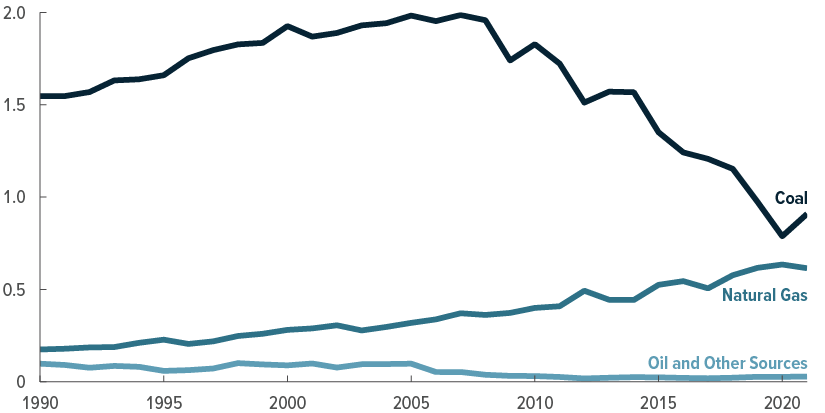
Emissions of Carbon Dioxide in the Electric Power Sector, by Energy Source from US Congressional Budget Office
This chart illustrates that there have been notable improvements in carbon dioxide emissions from the U.S. electrical sector, leading to the assumption that replacing coal with natural gas is the answer to reducing greenhouse emissions. However, methane emissions, which are often overlooked, are a significant concern.
Howarth’s paper suggests that exporting LNG to reduce coal consumption in other countries may actually increase overall greenhouse gas emissions. As a professor at Cornell University known for focusing on climate impacts of methane, Howarth’s findings have provoked strong reactions, especially from the fossil fuel industry.
In January 2024, the Biden administration temporarily paused new approvals for LNG exports to non-free trade agreement countries to reassess the environmental impacts. Existing contracts still allow for significant LNG exports to continue, affecting no immediate change to current operations.
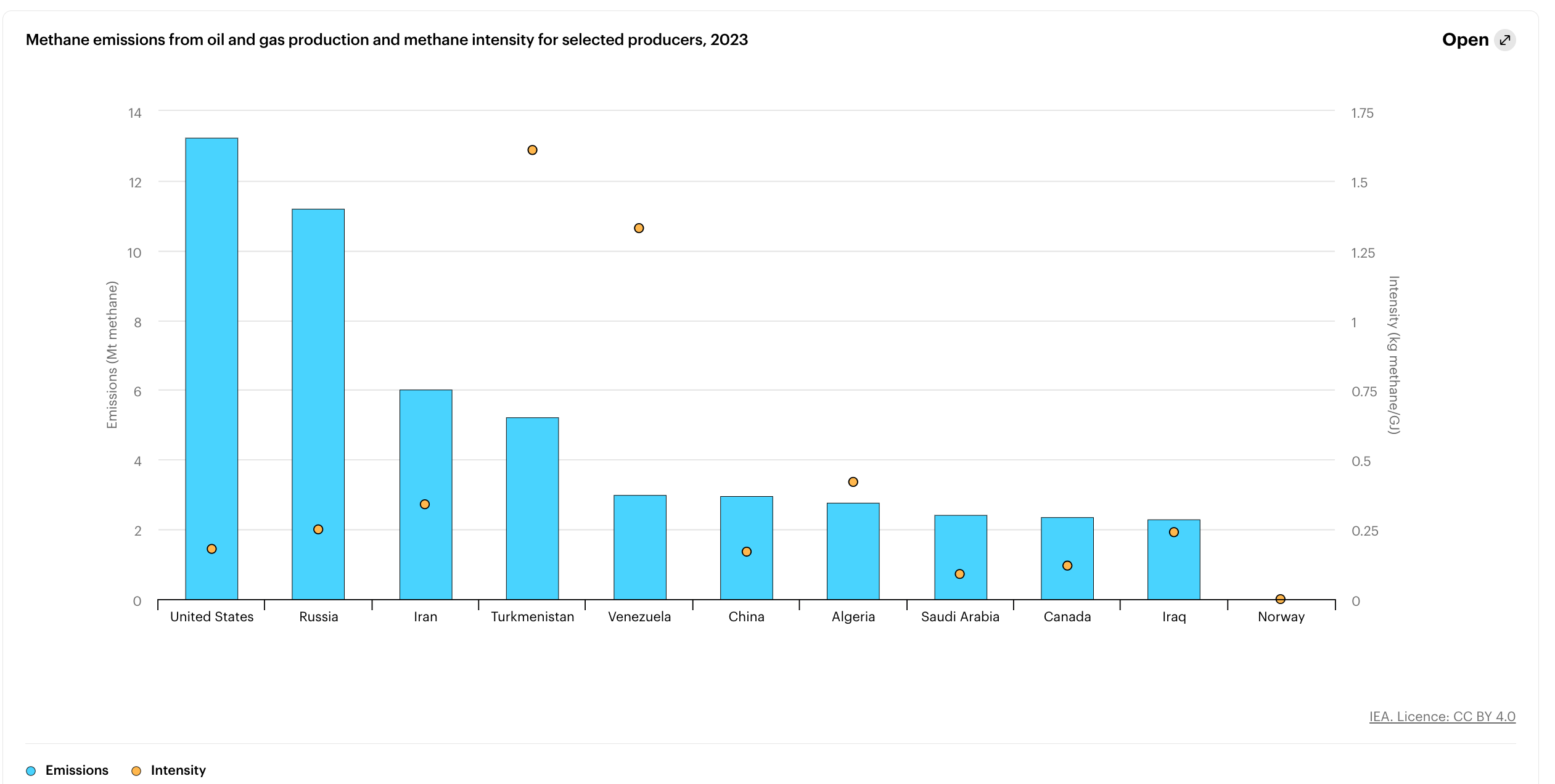
IEA methane tracker 2024 report on highest methane emitting countries.
Despite the pause in new approvals, methane leakage in the U.S. oil and gas industry remains a critical issue. Studies indicate that the U.S. leaks more methane than any other country, often at rates far exceeding government estimates.
The reason behind this leakage issue can partly be traced back to lax regulations within the fossil fuel industry, allowing for extensive gas venting practices. Shale oil production, particularly when fracked, plays a prominent role in this emissions problem.
Howarth’s research illustrates that the environmental impact of U.S. LNG exports is significant. He argues that the greenhouse gas footprint for LNG is actually 33% greater than that for coal, a conclusion that is inconvenient for the fossil fuel industry narrative.
Recent critiques from groups like the Breakthrough Institute challenge Howarth’s findings, but these critiques tend to lean heavily on alternative narratives promoting natural gas as a cleaner fuel, often overlooking the harmful methane emissions associated with its extraction and distribution.
Ultimately, while natural gas may be cleaner than coal under ideal circumstances, the current U.S. infrastructure and practices lead to significant emissions. Therefore, greater emphasis is needed on transitioning away from all fossil fuels towards more sustainable energy solutions.
Have a tip for CleanTechnica? Interested in advertising or suggesting a guest for our CleanTech Talk podcast? Contact us here.
CleanTechnica employs affiliate links. See our policy here.
Read CleanTechnica’s Comment Policy.